In many tourist destinations, there are spaces with high cultural, historical, or natural value that remain outside the usual visitor routes.
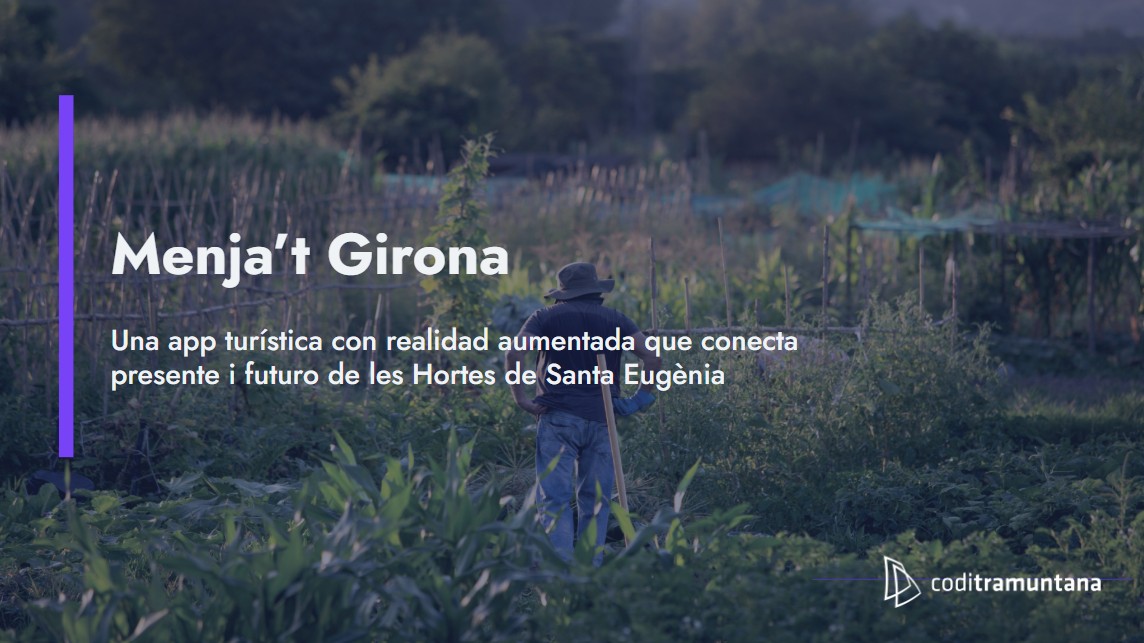
This was the case of les Hortes de Santa Eugènia, in Girona: an area with its own identity, but with low visibility within the tourism offering.
The challenge was not only to raise awareness, but to do so in a way that was consistent with the environment and accessible to any visitor.
To address this situation, the Girona City Council, together with Coditramuntana, promoted the development of a tourism app with augmented reality and offline functionality—an initiative that has already been publicly presented and covered by media such as Diari de Girona.
The goal: to transform the way users discover and understand the space, without relying on connectivity or technical knowledge.
The challenge: how to digitize the tourism experience without disrupting the environment.
The project posed several key challenges:
- Giving visibility to a space outside the traditional tourist circuit.
- Offering digital content without creating friction in the experience.
- Ensuring access in areas with low or no connectivity.
- Designing a solution usable by very diverse user profiles.
In this context, a standard app was not enough.
It was necessary to develop a technological solution adapted to the real conditions of use, not ideal ones.
The solution: development of a custom tourism app with augmented reality
A custom mobile application for tourism was designed and developed, based on a modular and scalable approach.
Guided and structured experience.
The application organizes the route into digital paths, where each point of interest offers relevant contextual content.
This allows:
- Guiding the user without the need for external intervention.
- Structuring the experience progressively.
- Facilitating understanding of the environment.
Educational and interactive content.
Historical, cultural, and environmental content was integrated, designed to be consumed quickly and accessibly.
The goal was clear: to inform without overwhelming.
Augmented reality applied to tourism.
The app incorporates augmented reality features that allow digital information to be visualized directly over the physical environment.
This provides:
- A higher level of interaction.
- Improved understanding of the context.
- A more immersive and distinctive experience.
Offline-first architecture: key in real environments.
One of the most critical aspects of the project was the development of an offline tourism app.
An architecture was implemented that allows:
- Full access to content without an internet connection.
- Stable performance in any location.
- Pre-download of optimized resources.
This ensures that the experience does not depend on the technological infrastructure of the environment.
Project development: technical decisions and approach.
The development focused on building a robust, usable, and scalable solution.
Main areas of work:
- UX design focused on non-technical users.
- Performance optimization on mobile devices.
- Efficient management of heavy multimedia content.
- Integration of augmented reality without affecting fluidity.
- Architecture prepared to scale new routes and content.
In addition, priority was given to ensuring the solution could be maintained and evolved by the client.
This approach allows the project not to be limited to a single initiative, but to grow over time.
Results: impact on the tourism experience.
The implementation of this solution made it possible to:
- Increase the visibility of a space outside the traditional tourist circuit.
- Improve the visitor experience through digital interaction.
- Facilitate autonomous access to cultural content.
- Create a reusable technological foundation for future initiatives.
Beyond the application itself, the project establishes a replicable model for the digitalization of local tourism.
Advantages of an augmented reality tourism app.
The use of this type of solution provides clear benefits:
- Improves the visitor experience.
- Increases interaction time with the environment.
- Allows content to be offered without relying on physical guides.
- Differentiates the destination from other offerings.
- Facilitates the digitalization of local tourism.
Why develop an offline tourism app
In many tourism projects, connectivity is a critical factor.
An offline tourism app allows:
- Ensuring usability in any environment
- Avoiding user frustration
- Ensuring continuity of the experience
- Reducing dependence on external infrastructure
This approach is especially relevant in natural environments or less urbanized areas.
Examples of the use of augmented reality in tourism.
Augmented reality enables multiple applications within the tourism sector:
- Historical reconstructions over real spaces.
- Visualization of disappeared elements.
- Informational layers over the environment.
- Interactive educational experiences.
This case demonstrates how these technologies can be applied in a practical and accessible way.
Who is this type of solution for?
This type of development is especially aimed at:
- Public administrations and city councils.
- Tourism management organizations.
- Cultural heritage projects.
- Destinations looking to differentiate their offering.
It is especially useful when:
There are under-recognized tourism assets.
- There is a need to improve the experience without major infrastructure.
- A scalable solution over time is desired.
What is an augmented reality tourism app?
An augmented reality tourism app allows digital information to be overlaid onto the real environment through a mobile device, enhancing the user experience with interactive, contextual, and immersive content.
Do you want to develop a tourism app like this?
If you are considering developing a custom tourism app, digitizing your visitors’ experience, or applying technologies such as augmented reality to your project:
We can analyze your case and propose a solution tailored to your context, objectives, and real usage environment.
Request a session and tell us your case.